Gladstone Rockwell
Gate CrashersGladstone Rockwell is a member of the American/European Union Parliament and one of the political forces who seek to take control of the ARTists project. Known in the political press as “Gladhand,” he is associated with relentless appropriation-winning and with the defense industry’s effort to claim space as its next strategic frontier. His importance lies less in technical expertise than in the way he converts scientific discovery into a question of military leverage: to Rockwell, alien surveillance means that humanity is being caged, and advanced technology must eventually produce the strength to confront whoever built the cage.
Identity and Political Base
Rockwell represents the Chicago-Milwaukee metropolitan area on paper, but the narrative makes clear that his effective constituency is Lockheed-Boeing-Raytheon, described as the largest defense contractor on the planet. His nickname, “Gladhand,” refers to his unrivaled ability to secure government appropriations for his home district. The contrast between formal representation and actual allegiance defines him: electoral geography provides his public legitimacy, while defense capital supplies the practical orientation of his politics.
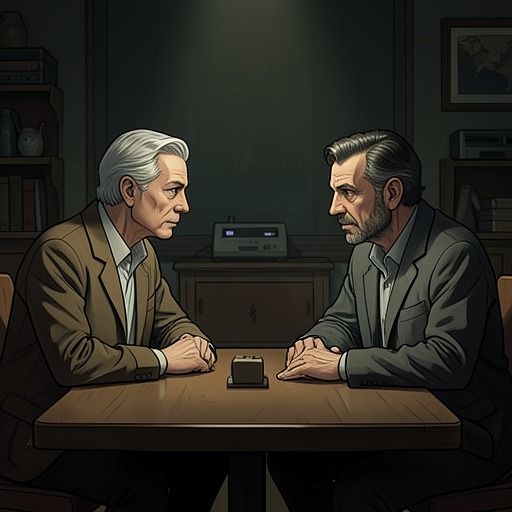
He enters a parlor where members of the American/European Union Parliament are being briefed on the ARTists program. Some attendees come from districts with major AESA research or industrial interests, while others are learning about the program for the first time. Rockwell is especially conspicuous to Eugene Graham because his presence confirms suspicions that the meeting concerns more than a routine scientific report. The description of him as wrinkled, missing buttons, and smelling of oak and bacon grease gives his political power a deliberately physical, almost comic texture, but the comedy does not diminish the institutional force behind him.
Technology, Threat, and Security
Rockwell claims to have only begun reading the reports when he praises Felix Fletcher’s work on faster-than-light propulsion. His remark alarms Eugene because the relevant information about the buoy’s faster-than-light communication had appeared in that morning’s report. Rockwell therefore appears to have received an earlier briefing, revealing that the project’s information channels extend beyond what Eugene believed he controlled. His interest is not merely in scientific achievement; it is in the speed with which achievement can become strategic capability.
When Eugene explains that the reverse-engineered technology does not currently offer a propulsion application, Rockwell immediately asks whether ships will still require decades to reach and confront the aliens. His choice of “confront” exposes the policy he brings into the room. Eugene objects that the word is loaded, but Rockwell answers that humanity has discovered it is being caged like zoo animals. The Human Wildlife Preserve warning has transformed an abstract mystery into a security narrative: an unseen external power is no longer simply observing humanity but is presumed to be confining it.
Danielle Fenton confirms that this interpretation has gained influence inside the government. The discovery of the alien buoy, the mystery ship, and the warning about a “wildlife preserve” have intensified cabinet tensions, and advisers want humanity to possess “some teeth” if first contact turns hostile. Fenton presents the intended policy as diplomacy combined with a show of strength. Rockwell’s language helps create the atmosphere in which that compromise becomes politically necessary, even though the evidence does not establish that he personally designed the entire policy.
Attempt to Seize the ARTists Project
Rockwell’s most direct intervention comes when he interrupts Eugene’s report on the project’s achievements. He arrives late, distressed, and disheveled, then recounts a series of failed prototype demonstrations before drawing his conclusion: it is time for qualified professionals to take the reins of the ARTists project. His attack is carefully framed. He acknowledges Eugene’s success in assembling the team and praises its contributions, but labels the researchers a “ragtag bunch” and argues that the program has reached a stage where amateurs should no longer control it.
The proposed transfer of authority exposes the conflict between the ARTists’ improvised scientific culture and the permanent institutions waiting to absorb its results. Eugene’s stomach tightens because he has anticipated the political strike, yet anticipation cannot soften its consequences. Rockwell’s rhetoric makes competence itself a political possession: the team is celebrated for producing the breakthrough, then treated as insufficiently professional to determine what the breakthrough will mean.
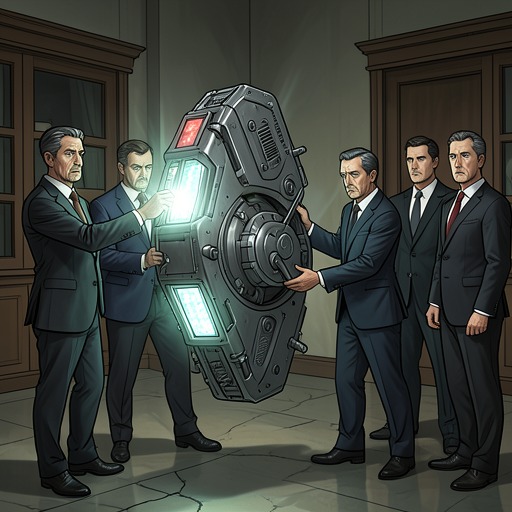
The attempted takeover is paired with a concealed military program. Eugene believes construction of the Bucephalus has been suspended until the ARTists hyperspace generator is ready, but Rockwell reveals that this is what he and everyone else were supposed to think. Danielle clarifies that the president authorized both programs to proceed in parallel. Construction of the Bucephalus resumed the week after the first successful hyperspace-window test; the vessel is essentially complete, has undergone stationary trials, and awaits integration of the generator. Rockwell’s role in exposing the arrangement places him on the side of strategic acceleration and institutional control, while Eugene recognizes that his team may be thanked for its work and then pushed aside.
Institutional Power and Consequences
Rockwell’s intervention demonstrates how scientific secrecy creates the conditions for political capture. The ARTists had established a shell corporation to hold new patents, financed by venture capital alongside AESA’s black budget, while remaining vulnerable to anyone who investigated the arrangement closely. The project’s success expands its resources but also increases the number of institutions and interests capable of claiming it. Rockwell represents the point at which hidden research becomes a prize large enough for defense contractors and legislators to contest openly.
His politics also sharpen the book’s distinction between civilian exploration and military preparedness. Space had remained largely free of weapons under the Outer Space Treaty and the broader informal convention against offensive weapons, but Rockwell’s presence signals that the old restraint is under pressure. The alien preserve becomes an argument for deterrence; deterrence becomes an argument for parallel construction; and parallel construction becomes a means of displacing the researchers who made the new technology possible.
Rockwell is consequently less a conventional villain than an institutional catalyst. He does not need to understand every technical detail to alter the project’s direction. By asking whether the technology can reach the aliens, by treating confinement as an act of aggression, and by demanding professional control, he turns uncertainty into urgency and urgency into militarization. The narrative’s irony is that the project’s most consequential danger may arise not from a proven alien attack but from the human political response to incomplete knowledge.